
Improve your type 2 diabetes
Treating my excess weight to treat my diabetes
Hard to believe !
For months, perhaps years, you have been taking medicines to treat your diabetes, convinced it was the only option available.
Well — know that today you can take back control of your illness by losing the kilos you carry in excess.
Treating my excess weight to treat my diabetes
Read more here...
Treating my excess weight to treat my diabetes
Hard to believe !
For months, perhaps years, you have been taking medicines to treat your diabetes, convinced it was the only option available.
Well — know that today you can take back control of your illness by losing the kilos you carry in excess.
Treating my excess weight to treat my diabetes
Read more here...
Food Monad : the answer
The Food Monad will help you shed your surplus kilos for good. Which means that once your goal is reached, it is quite possible you will be able to reduce the dose of your medicines, and then their number…
Food Monad : the answer
The Food Monad will help you shed your surplus kilos for good. Which means that once your goal is reached, it is quite possible you will be able to reduce the dose of your medicines, and then their number…
Towards recovery
Your recovery will therefore come through getting rid of your excess weight. But how do you work out how many kilos you carry in excess ?
We suggest setting yourself an extremely simple goal : reaching the weight that matches your height above one metre.
Towards recovery
Your recovery will therefore come through getting rid of your excess weight. But how do you work out how many kilos you carry in excess ?
We suggest setting yourself an extremely simple goal : reaching the weight that matches your height above one metre.
A few facts about diabetes...
Type 1 and type 2 diabetes
Type 1 and type 2 diabetes do not have the same origins.
Type 1 diabetes is a disease in which the pancreas no longer produces insulin. In type 2 diabetes, the problem is insulin working badly. The treatments are therefore different.
In type 1, insulin must be given daily from the moment the disease is found.
In type 2, medicines are given that stimulate and/or improve insulin production.
90 % of people with diabetes have type 2 (insulin working badly) and 10 % have
type 1 (no insulin production at all).
Complications of diabetes
Blood flows through every vessel in the body. In type 1 as in type 2 diabetes, it carries too much sugar. After several years, it is this prolonged high blood sugar that damages the vessels.
The complications are therefore many, and can be serious: peripheral arterial disease, stroke, cardiovascular disease (heart attack, high blood pressure, heart failure), kidney failure (damage to the small vessels of the kidney).
What should also be remembered is that the more the weight rises, the more unstable the diabetes becomes — which steadily increases the complications.
The spread of diabetes worldwide
The figures given here are those published by the WHO and the International Diabetes Federation.
In the 1980s, 108 million people had type 2 diabetes. That figure reached 422 million in 2014.
And in 2021, the International Diabetes Federation reported a further rise, with 537 million people affected worldwide (adults aged 20 to 79).
As for global forecasts, it is estimated that by 2030 there will be 643 million people with diabetes, and that by 2045 the figure will reach 783 million, if nothing is done to improve the situation.
In France there are currently close to 4 million people with type 2 diabetes, 75 to 80 % of them overweight. That is 3 million people who could see a remarkable improvement in their illness simply by reducing their excess weight.
UNDERSTANDING TYPE 2 DIABETES
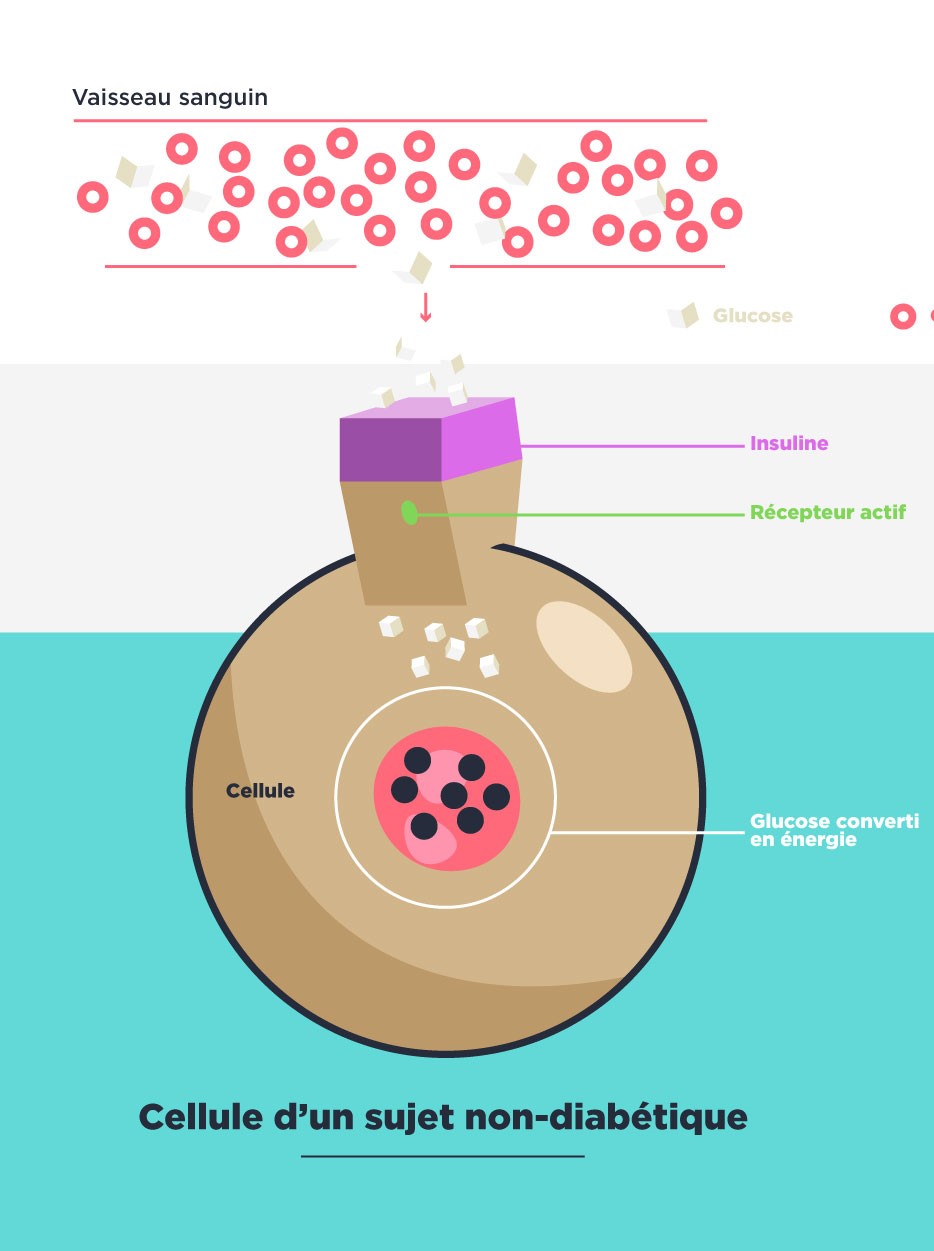
How insulin works
How does insulin work?
The sugar our food provides is turned into glycogen, which is stored in the liver and the muscles.
According to the body's needs, that glycogen is released into the bloodstream to be used by every cell in our organs.
Produced by the pancreas, insulin is the hormone that regulates sugar — glucose — in the body. Its role is to bring glucose inside the cells, where it is used to produce energy.

When insulin works properly, it maintains a balance that holds blood sugar at around 1 g/l. That is what happens in a person without diabetes.
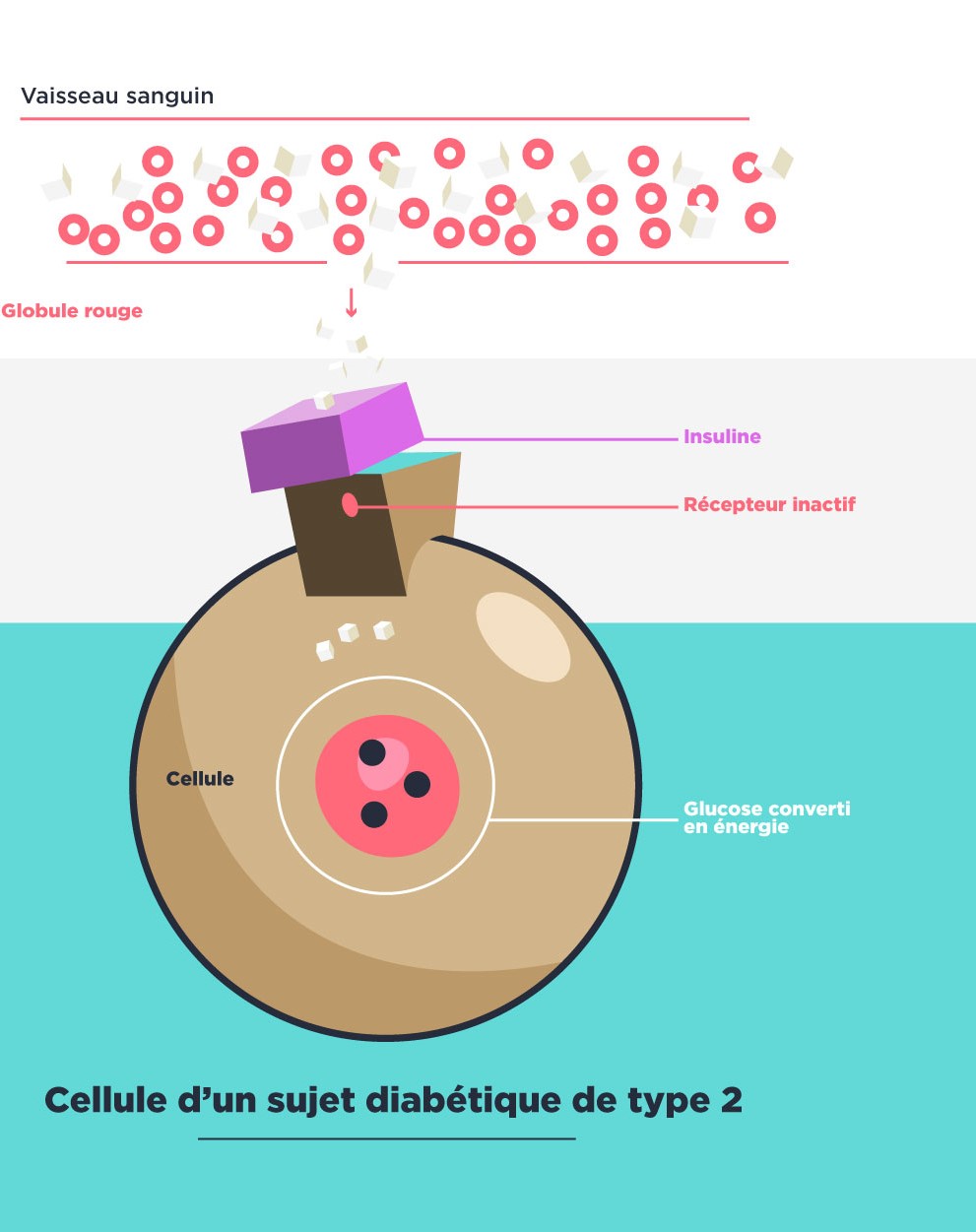
How type 2 diabetes works
What is the mechanism of type 2 diabetes?
In type 2 diabetes, insulin no longer binds properly to the cell at the receptors meant for it, and glucose no longer passes into the cell — or passes poorly.
Blood sugar then rises above the normal level of 1 g per litre. This is INSULIN RESISTANCE, the first mechanism behind type 2 diabetes.
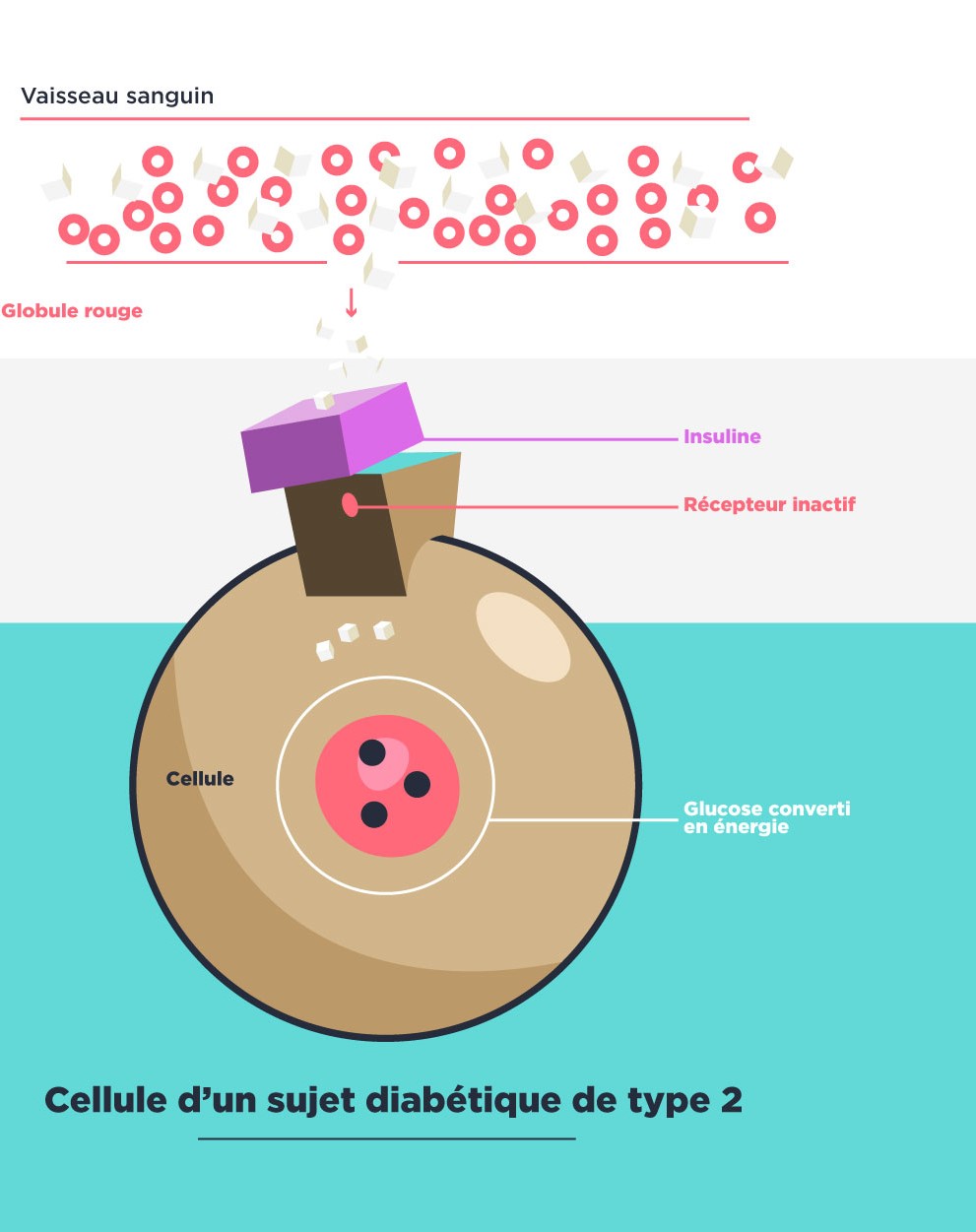
Later, after several years, insulin — constantly called upon because of this poor functioning — exhausts the pancreas. Production becomes insufficient. This is INSULIN DEFICIENCY, a shortfall in insulin production.
It is the second mechanism behind type 2 diabetes.
What causes INSULIN RESISTANCE ?
Type 2 diabetes is partly genetic. To develop it, you must carry predisposing genes. Some people, even markedly overweight, will never develop type 2 diabetes, quite simply because they do not have those genes. But once they do have them, another phenomenon steps in and worsens insulin resistance. That is what the next section explains.

Abdominal fat and diabetes
Abdominal fat and type 2 diabetes
The abdominal fat of overweight people with diabetes releases hormonal compounds that amplify INSULIN RESISTANCE.
Remove that abdominal fat and it stops releasing those substances: insulin can work again and bind to the cell. That is what happens in people with type 2 diabetes who undergo bariatric surgery.
It follows that the number one treatment for an overweight patient at the onset of type 2 diabetes is, before any medicine is prescribed, to lose the surplus kilos (returning to their height above one metre).
And for a patient already treated for months or years, the goal is the same.
They can then hope to stabilise the illness and improve how it develops.
Careful !! : IMPROVEMENT will not in every case mean A COMPLETE CURE, particularly in people whose diabetes has already been running for 15 or 20 years, but any remission is always preferable to the inexorable course of type 2 diabetes, whose many fearsome complications are all too well known.
Testimonials


At the end of the 5th month, I was at – 12 kg and my haemoglobin had come down to 5.7, that is to say below six, which is the mark for not having diabetes.
— Maryam

The results did not keep me waiting; more than 2.5 kilos by the end of the very first week! then 1.5 kg in each of the next two,
— Nadège
It took me between four and five months to get to – 15 kg. I know you can do better. But I got there and I am proud of it. All the more so as, over the following months, I managed to lose another 3 kg. Today, I have lost 18 kg in all.
— Mathilde
At the end of the 5th month, I was at – 12 kg and my haemoglobin had come down to 5.7, that is to say below six, which is the mark for not having diabetes.
— Maryam
from those extra kilos?